
The Queens County Clerk of Court is the official county office responsible for filing, recording, and maintaining civil court and property records in Queens, New York. The queens county clerk office supports Supreme Court and Civil Court cases by managing verified legal documents used by courts, attorneys, and the public. This office serves as the primary source for official filings related to civil actions and real property matters. Records kept by the Queens County Clerk of Court form the legal history for many court proceedings and property transactions. Accurate record management helps courts operate efficiently and keeps filings properly documented.
The Queens County Clerk of Court handles civil case filings, index number records, judgments, and real estate documents such as deeds, liens, and mortgages, serving as a primary record-keeping office for matters heard within the Queens County Courts. These records support cases associated with the Queens Supreme Court and Queens Civil Court and are used for legal filings, property ownership verification, and court case history research. Many documents are submitted electronically or in person, helping ensure that records maintained by the Queens County Courts remain current, accurate, and reliable. Common search intent includes Queens civil court records, Queens Supreme Court case search, property record filings, and requests for certified court documents.
What is the Queens County Clerk of Courts?
The Queens County Clerk of Court serves as the central office for court administration and official records in Queens County. This office manages filings, maintains legal documentation, and supports daily court operations across the county.
As of 2026, the Queens County Clerk of Court is Audrey I. Pheffer, who has served in this role since 2011. Pheffer brings a strong background in public service and court administration to the office, having previously served nearly 24 years in the New York State Assembly before becoming Clerk. Under her leadership, the Clerk’s Office has modernized many court administrative functions, including expanding online access to records and improving public access services. Her continued focus on transparency, accessibility, and operational efficiency helps ensure that filings, records, and court processes in Queens County are managed accurately and reliably for both the public and legal professionals.
What the Queens County Clerk of Courts Does
The Queens County Clerk of Court acts as the administrative backbone of the county’s judicial system. The office receives, processes, and stores a wide range of court documents tied to civil, criminal, and family-related matters. Through this role, the Clerk supports transparency and record accuracy across Queens County courts.
Court administration duties focus on record handling rather than case decisions. Judges hear cases and issue rulings. Courts host hearings and trials. The Clerk of Court manages the paperwork that supports each step of those actions. As a result, the office keeps case files organized, searchable, and preserved over time.
Key responsibilities include:
- Filing and indexing court cases
- Maintaining official records and case histories
- Managing court calendars and filings
- Issuing certified copies of court documents
- Collecting court fees and fines
These tasks support legal documentation oversight and help the justice system run smoothly.
Role Within Queens County’s Judicial System
Queens County operates within New York’s Unified Court System, which includes several courts serving different case types. The Clerk of Court works alongside these courts by handling administrative functions that judges and court staff do not perform. The office does not provide legal advice or influence outcomes. Its focus stays on records, filings, and court administration. For example, once a judge signs an order, the Clerk records and stores it as part of the official case file. That separation of duties protects fairness and accuracy across the system.
Common records maintained by the Clerk include:
- Civil court filings
- Criminal case records
- Judgments and orders
- Liens and legal notices
- Jury-related documentation
Through consistent record management and public service support, the Queens County Clerk’s Office plays a key role in keeping Queens County’s courts organized, reliable, and accountable.
How to Access Queens County Court Records
Queens County court records can be searched online or in person at the Clerk’s office. Most public court records are available for viewing by the general public, though some documents require special requests or have access limits.
Many people start with the official online search tools because they save time and let users check basic case information without a courthouse visit. For more detailed records or certified copies, a formal request or in‑person visit may be necessary.
Online Court Records
Public users can search Queens County court records using official state court websites. These provide free record search tools, basic case details, and links to related systems:
- Queens County Clerk Case Search (Official): Search civil, criminal, and business records filed with the Clerk’s office. Visit the Queens Clerk search portal here: https://iapps.courts.state.ny.us/webccos/queenscc/
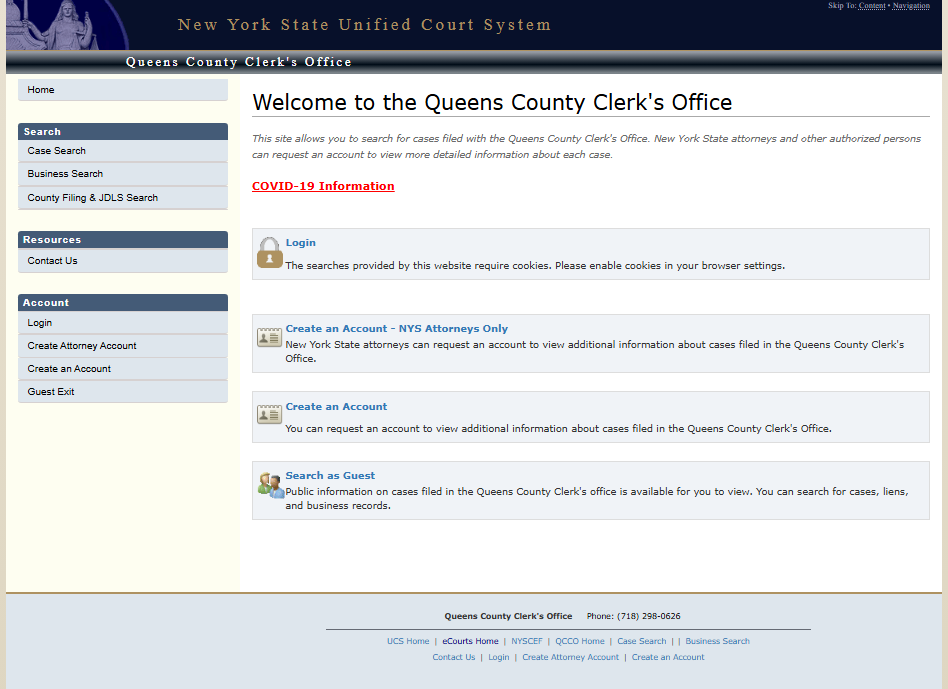
- NY Courts eCourts Case Information: Browse public case details across various New York courts using party name or case number.
Online searches let users see docket numbers, parties, filing dates, and next court dates without visiting a courthouse. Some systems also include calendars and status updates. If users need full documents or certified copies, they may need to submit an official request.
Tips for online searching:
- Have the case number or party name ready for faster results.
- Some portals require a guest login to view records.
In‑Person Access and Certified Copies
When records are not fully available online, visiting the Queens County Clerk’s Office in Jamaica, NY lets people request specific files or certified copies. The Clerk’s staff can help with:
- Searching archived case files
- Providing certified copies of court documents
- Explaining fees and timelines
Certified copies are often needed for legal matters and official purposes. The Queens Clerk’s Records Search Department also handles requests for older cases and documents not digitized.
What Records Are Public
Most court records are public unless restricted by law. Public court records commonly include:
- Civil case filings and judgments
- Criminal case listings and outcomes
- Traffic and small claims records
Some records are restricted or sealed. These include juvenile court files and certain family or adoption records.
Fees, Restrictions, and Timelines
Accessing records may involve fees. Common charges include:
- Copy fees per page for general documents
- Higher fees for certified copies
- Search certificate fees from the Clerk’s office for record lookups
In‑person copies may be available the same day, while mailed or formal requests take longer. Online access to basic case information is usually free.
Clerk Services in Queens County
The Queens County Clerk of Court provides a wide range of clerk services that support filing, document processing, and daily court administration. These services help keep court records accurate, timely, and available for public and judicial use.
The Clerk’s Office serves as a central point for managing court-related paperwork in Queens County. It handles records from civil cases, criminal matters, and other legal proceedings filed with the court. Through structured filing services and standardized document processing, the office supports judges, attorneys, and the public with reliable record handling. This section groups the main clerk services at a high level, with deeper service details covered later on the page.
Filing Services and Record Intake
Filing services form the foundation of clerk services in Queens County. The Clerk’s Office receives, timestamps, and records legal documents submitted for court cases. This process creates an official court record and places the document into the case file.
Common filing services include:
- Civil case filings, such as summonses, complaints, and motions
- Criminal case filings submitted by prosecutors and defense counsel
- Judgments, orders, and court decisions
- Appeals-related paperwork forwarded to higher courts
Many filings follow strict formatting and fee rules set by court administration. Since deadlines apply, the Clerk’s Office tracks submission dates closely. Some filings may take place in person, by mail, or through approved electronic systems, depending on case type. Clear intake steps help reduce delays and maintain orderly court operations.
Document Processing and Official Records
Document processing supports the long-term handling of court records. After filing, documents move through indexing, scanning, and verification steps. These steps help preserve record accuracy across physical and digital systems.
Key document processing services include:
- Indexing case records by name, number, and filing date
- Scanning paper filings into electronic record systems
- Certifying copies of court documents upon request
- Recording liens, judgments, and legal notices
Certified copies often serve legal or administrative needs. The Clerk’s Office applies official seals and signatures to confirm authenticity. Processing times may vary based on request volume and record age. Clear tracking systems support efficient record retrieval for both court staff and the public.
Court Administration Support Services
Court administration relies on clerk services to keep proceedings organized and on schedule. The Clerk’s Office coordinates closely with judges, courtrooms, and administrative units across Queens County.
Administrative support services commonly include:
- Managing court calendars and hearing schedules
- Maintaining case status updates in court databases
- Handling jury-related records and paperwork
- Collecting and recording court fees and fines
Through these functions, clerk services help courts operate smoothly each day. Accurate data entry supports case flow and reduces scheduling conflicts. Court administration teams depend on timely clerk work to maintain orderly proceedings across multiple court divisions.
Court Filing Services & Document Processing
The Queens County Clerk of Court handles filing services for civil and criminal matters, making sure legal documents are properly submitted and processed in accordance with court rules. This includes filings related to the Queens County Supreme Court, which has jurisdiction over major civil cases and felony-level criminal matters. Individuals, attorneys, and government agencies can file cases at the clerk’s office or through approved online portals, following required formats, procedures, and deadlines established by the Supreme Court and other courts. Civil filings often include complaints, petitions, or motions, while criminal filings may involve indictments, complaints, or motions related to felony or misdemeanor cases heard in the Supreme Court or lower courts. The clerk’s office reviews submitted documents, assigns case numbers, and manages the court case processing workflow to support efficient case tracking and judicial administration.
Types of Cases Accepted
The clerk accepts a wide range of cases, including civil disputes like contract or property claims, landlord-tenant issues, and small claims, as well as criminal matters such as felony and misdemeanor charges. Family court cases involving custody, support, or domestic issues are also handled, along with traffic violations, fines, and appeals. Each filing is carefully reviewed to ensure compliance with court standards, creating an official record and enabling timely scheduling for hearings and proceedings.
Additional Services
Beyond basic filings, the clerk’s office provides verification and certification of documents, assists with filing fees, and helps filers identify the correct forms for their case type. By offering clear guidance and managing all submitted documents, the office ensures legal paperwork is accurately recorded and ready for the court, minimizing delays and supporting smooth legal document submission for all involved parties.
Official Records Maintained by the Clerk
The Queens County Clerk of Court keeps a wide range of official records that are critical for legal, financial, and property matters. These records include court records, land documents, judgments, liens, and other public filings.
The Clerk’s office serves as the official repository for documents generated through civil, criminal, and property proceedings. These records provide a reliable reference for legal disputes, ownership verification, and historical documentation. Citizens, attorneys, and government agencies rely on these documents to confirm legal standing or investigate prior transactions.
Types of Records Held
The office maintains several categories of court and public records, including:
- Civil court records: Complaints, motions, judgments, settlements, and other filings related to non-criminal disputes.
- Criminal court records: Case filings, indictments, convictions, and sentencing information.
- Family and probate records: Wills, estate documents, guardianship filings, and divorce records.
- Land records and property filings: Deeds, mortgages, easements, liens, and other property-related documentation.
- Judgments and liens: Publicly filed court judgments that may affect credit or property ownership.
These records are carefully logged, indexed, and preserved to ensure accuracy and legal validity. Each document is assigned a case or filing number, making it easier for staff and the public to locate specific information when required.
Legal Importance and Use
Records maintained by the Clerk hold significant legal weight. They serve as official evidence in disputes, support title searches for real estate transactions, and provide authoritative proof for financial or contractual matters. Attorneys and lenders often reference these filings to verify prior judgments, liens, or other obligations. Government agencies use the records for compliance, enforcement, and policy review. Maintaining accurate records also ensures transparency in court proceedings and protects the rights of all parties involved. Many of these documents are used repeatedly in civil, criminal, and property law cases, highlighting the Clerk’s role as a trusted record keeper.
Access Limitations and Availability
While most public records are available for inspection, some filings have restrictions due to privacy, security, or legal regulations. For example, adoption records, juvenile cases, or sealed court filings require special permission to view. The Clerk provides guidance on permitted use, request procedures, and any associated fees for obtaining certified copies.
Record Requests, Copies & Certifications
Certified records and official copies are available through the Queens County Clerk of Court for various legal and personal purposes. Certification confirms that a record is an accurate and official copy of the original document.
When requesting documents, it’s important to know the difference between certified and uncertified records. Certified records include a seal or signature from the Clerk’s office, proving authenticity for legal, financial, or government purposes. Uncertified copies are simply duplicates of original records and may not be accepted for formal processes.
How Record Certification Works
The Clerk of Court provides record certification by verifying that a copy matches the original document held in court files. The process generally involves:
- Submit a written request or complete an online form.
- Paying any required fees for certification or official copies.
- The Clerk reviews the original record and adds a certificate, seal, or stamp to confirm its authenticity.
Certified documents are often needed for court filings, immigration paperwork, property transactions, or employment verification. They carry official recognition and are widely accepted by legal authorities.
When Notarization or Authentication Is Needed
Some certified records may require notarization or authentication, depending on their intended use. For example:
- Legal proceedings outside New York may require a notarized certification.
- Certain foreign authorities or government agencies may request additional authentication, such as an apostille.
The Clerk’s office can advise you on whether notarization is necessary for your records. In most cases, certified copies from Queens County are sufficient for local legal matters, including civil and criminal cases.
Fees, Processing Times & Payment Methods
The Queens County Clerk of Court charges fees for filing documents and requesting official records. Payment options and processing times vary depending on the service type and method of submission. These fees and timelines help residents plan and avoid delays. Filing fees are applied when submitting new cases, motions, or legal documents, while record request fees cover copies, certifications, or notarization services. Fees are clearly listed on the Clerk’s official website and at courthouse offices.
Filing and Record Request Fees
- Filing Fees: Applied to case submissions, motions, or other court documents. Typical amounts range from $50 to $400, depending on the case type.
- Record Request Fees: Charged for obtaining certified or uncertified copies of court records. Certified copies usually cost slightly more due to authentication requirements.
- Service Charges: Some services, such as notarization or expedited processing, include additional charges.
Fees can be paid in several ways:
- Cash (accepted in person at all Clerk locations)
- Checks or Money Orders (payable to “Queens County Clerk of Court”)
- Credit/Debit Cards (available for in-person transactions; some online requests accept card payments)
Processing Timelines
Processing times depend on the type of request:
| Service Type | Typical Timeline |
|---|---|
| Standard record requests | 5–10 business days |
| Certified copies | 7–15 business days |
| Expedited requests | 2–3 business days |
| Court filings (in-person) | Immediate to same day |
| Online filings | 1–2 business days |
Common Issues When Dealing With the Clerk’s Office
Many people face delays or document rejections when using clerk services in Queens. Common problems include filing errors, missing information, or documents that do not meet court requirements.
These issues often occur because court forms have strict rules, and even small mistakes can lead to rejected documents. For example, forgetting to sign a form, submitting the wrong fee, or using outdated templates can slow down processing. Filing errors are among the most frequent reasons cases are delayed, leaving users frustrated and uncertain about the next steps.
Frequent Document Problems
When dealing with the Clerk’s Office, several issues tend to appear repeatedly:
- Rejected filings: Documents missing signatures or pages are returned, delaying case processing.
- Incorrect formatting: Court forms must follow precise formats, including margins, fonts, and dates.
- Payment issues: Fees must be exact and submitted through accepted methods; errors can result in rejection.
- Incomplete information: Missing addresses, case numbers, or supporting documents can prevent acceptance.
Keeping track of these requirements before submitting forms can prevent unnecessary delays. Some clerks’ offices offer checklists or guidance sheets to help reduce errors.
Tips to Avoid Common Delays
Even without direct guidance, certain practices help minimize filing mistakes:
- Review each form carefully and confirm all required fields are completed.
- Verify current fees and acceptable payment methods for your filing type.
- Make copies of every document before submission for reference.
- Ask staff for clarification on unclear instructions—they can often provide quick solutions.
Clerk Office Locations & Jurisdiction
The Queens County Clerk’s office is located at 88‑11 Sutphin Boulevard, Jamaica, NY 11435, and serves as the central hub for managing court records and filings. Its jurisdiction covers the Queens County Supreme Court, Civil Court, and Family Court. The main clerk’s office handles records for civil and criminal cases, property filings, certifications, and official document requests. Court offices in Queens coordinate closely to ensure filings and administrative tasks are processed efficiently.
Courts Within the Clerk’s Authority
The clerk maintains records and provides administrative support for several courts:
Queens County Supreme Court
- Handles major civil and criminal cases, including significant civil lawsuits, felonies, and appeals.
- Phone: +1 (718) 298‑1000
Queens Civil Court
- Oversees small claims, housing disputes, and civil matters of limited monetary value.
- Phone: +1 (718) 262‑7138
Queens Family Court
- Manages child support, custody, domestic violence, and adoption cases.
- Phone: +1 (718) 298‑0197
- Email: queensfamilycourt@nycourts.gov
Additional Services
Beyond record management, the clerk’s office supports filing and administrative services for residents and legal professionals:
- Filing property and mortgage records
- Issuing official copies of court documents
- Processing certifications and notarizations
- Handling general inquiries and record requests
Queens County Clerk’s Office Contact
- Address: 88‑11 Sutphin Boulevard, Jamaica, NY 11435
- Phone: +1 (718) 298‑0626
- Email: queensclerk@nycourts.gov
The Queens County Clerk’s office acts as the administrative center for multiple court offices, ensuring that civil, family, and Supreme Court records are maintained accurately and efficiently.
(FAQ) About the Clerk of Court
The Queens County Clerk of Court handles court records and administrative tasks for the county. The office provides official documents, record services, and support for court-related processes.
Can I File Documents Online?
Yes, certain documents can be filed electronically through the Queens County Clerk’s Office. Many civil and family court cases allow electronic filing, which saves time compared to visiting the office in person. Users may need to register for an e-filing account, and all documents must meet the office’s formatting and submission standards. Filing fees for online submissions can usually be paid using credit or debit cards. E-filing ensures that documents are securely received, officially timestamped, and processed efficiently, helping citizens and legal professionals complete filings without delays.
Are All Court Records Public?
Most court records maintained by the Queens County Clerk’s Office are available to the public, but certain cases are restricted to protect privacy. Juvenile cases, sealed family matters, and other sensitive documents may not be accessible without court approval. Even in public cases, some personal information may be redacted to comply with privacy rules. The Clerk’s Office balances transparency with legal protections by maintaining official records while controlling access to sensitive information, allowing the public to request records while safeguarding confidential details.
How Long Does Record Processing Take?
Processing times at the Queens County Clerk’s Office depend on the type of document or request. Standard filings and routine record requests are usually completed within a few business days, while more complex cases may require additional time. Certified copies, special orders, or records that need verification may take longer to process. The office works to ensure that all official records are accurate and complete so that legal professionals, citizens, and government agencies can rely on timely and trustworthy documentation for their needs.
Can I Get Certified Copies?
Certified copies of official court documents are available from the Queens County Clerk’s Office. These copies include an official seal and signature, making them legally valid for use in courts, government agencies, or business matters. Certified copies are commonly requested for records such as marriage certificates, divorce judgments, civil filings, and other legal documents. Requests can usually be made in person, by mail, or online if supported, and the office collects a fee for each certified document. Having a certified copy ensures that individuals have an authoritative, legally recognized record for any official purpose.
Is This Office Part of the Court?
Yes, the Queens County Clerk’s Office is an official part of the court system and plays a central role in court administration. The office maintains official records, manages filings, collects service fees, and provides assistance to judges, staff, and the public. By handling these administrative tasks, the Clerk Office supports the smooth operation of civil, criminal, and family courts, offering reliable services that allow attorneys, citizens, and government agencies to interact effectively with the court system.